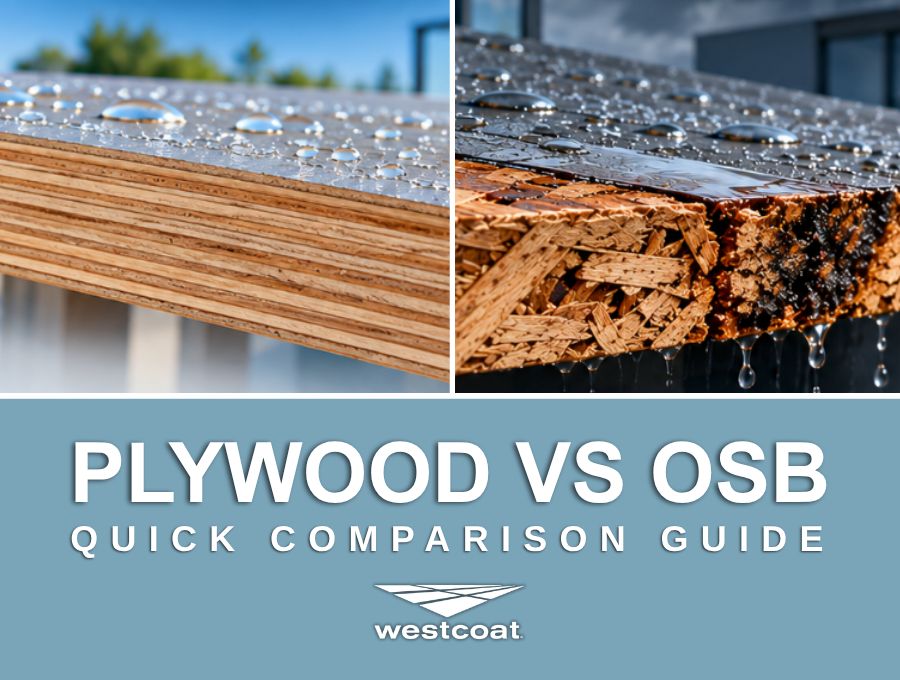

Plywood vs. OSB for Waterproof Decks: Choosing the Right Deck Substrate
by Michelle
- October 7th, 2026 /
- Education,Waterproofing
When building a waterproof deck, balcony, walkway, or roof deck over wood framing, the material beneath the waterproofing matters.
Plywood and oriented strand board (OSB) are both widely used structural wood panels. In many construction applications, either material may be appropriate when properly specified. But that does not mean plywood and OSB are interchangeable beneath every waterproof deck coating system.
For Westcoat’s ALX™ Pro Waterproofing System, the answer is direct: ALX Pro is designed for plywood, and the current system specification identifies OSB as an unsuitable substrate. Westcoat specifies a minimum 5/8-inch CDX or exterior-grade plywood, with 3/4-inch plywood preferred.
Why does that distinction matter?
Because a waterproof deck is not simply a coating applied to whatever happens to be underneath it. It is a complete assembly:
Joists → Plywood substrate → Waterproofing system → Protective/decorative finish
The substrate supports every layer above it. Its stiffness, dimensional movement, moisture condition, seams, fastening, slope, and compatibility with the specified waterproofing system can all affect long-term performance.
The principle is simple: Specify the assembly, not just the coating. The substrate is part of the waterproofing system.
Plywood vs. OSB: What’s the Difference?
At first glance, plywood and OSB appear to solve the same problem. Both are engineered structural wood panels used extensively for walls, roofs, floors, and other framed construction.
Their construction, however, is very different.
What is plywood?
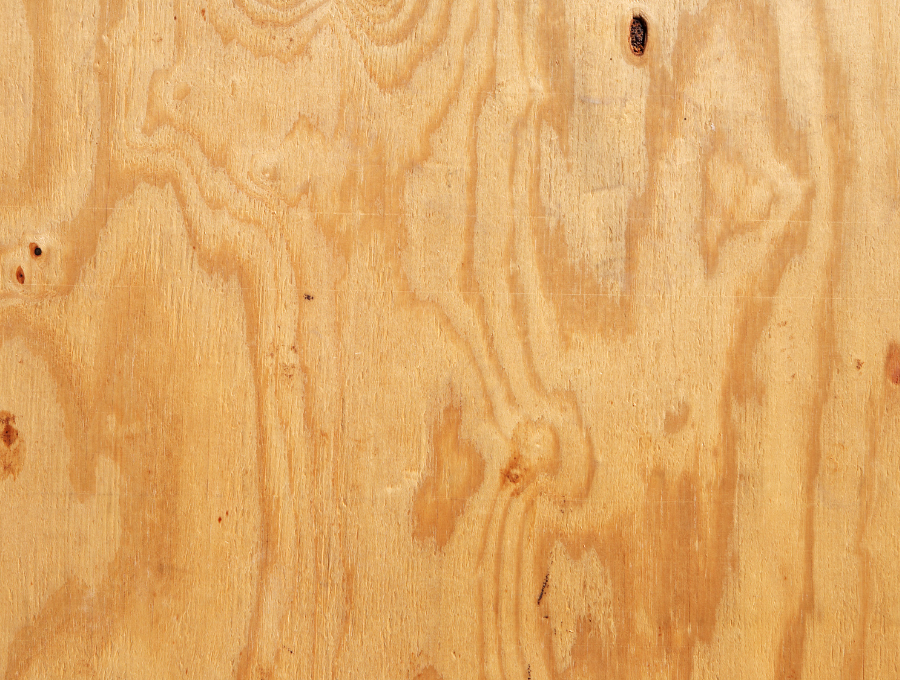
Structural plywood is manufactured from thin sheets of wood veneer. The veneers are bonded together in layers, with the grain direction alternating between adjacent layers.
This cross-laminated construction distributes strength in multiple directions and helps create a relatively dimensionally stable panel.
Plywood is available in numerous grades, thicknesses, veneer qualities, span ratings, and bond classifications. Those distinctions are important: the word plywood alone does not tell an architect or contractor whether a particular panel is appropriate for a particular exterior application.
APA recognizes both Exposure 1 and Exterior plywood. Exterior-rated panels are designed for repeated wetting and drying or long-term weather exposure, while Exposure 1 panels are intended for applications where long-term weather exposure is not expected. APA Wood
What is OSB?
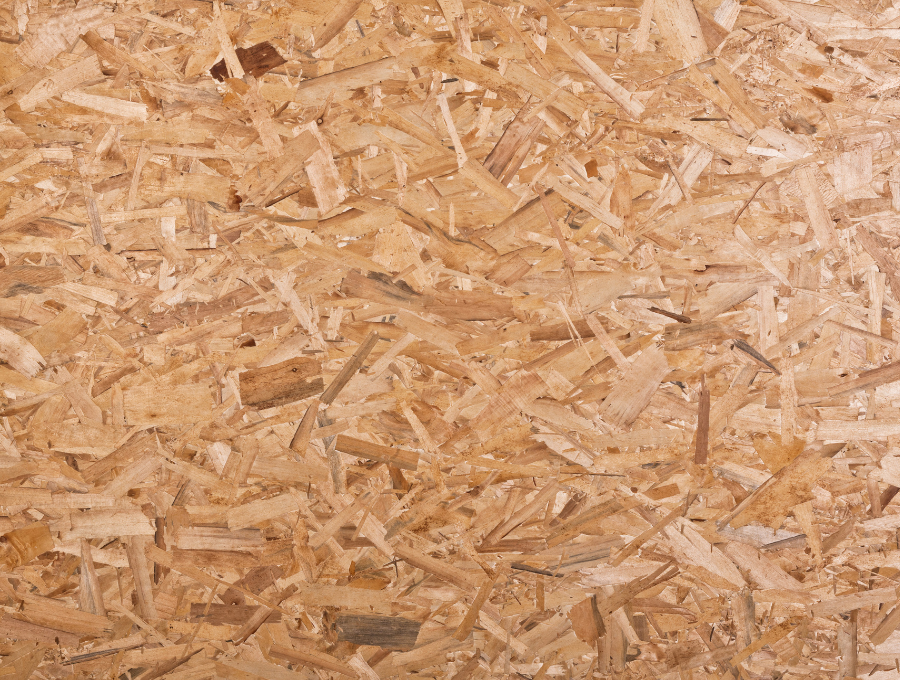
Oriented strand board is manufactured from wood strands rather than continuous veneers. The strands are arranged in layers, oriented primarily in particular directions, combined with adhesives and other additives, and compressed under heat and pressure into a structural panel.
Modern OSB is a widely accepted structural material. It is commonly used for wall and roof sheathing and subfloor applications, and APA-certified OSB can meet recognized structural performance standards. APA Wood
That is an important distinction for this discussion: OSB is not inherently a “bad” building material.
The relevant question is whether a particular OSB panel is appropriate for the intended exposure and whether the waterproofing system being installed over it permits OSB as a substrate.
For ALX Pro, it does not.
Are OSB and plywood structurally equivalent?
In many structural applications, code-recognized plywood and OSB panels can provide comparable structural functions when the correct panel grade, thickness, span rating, fastening, and installation requirements are followed.
But structural acceptability is only one part of the decision.
A panel can be structurally appropriate for a wall, roof, or interior floor assembly and still not be an approved substrate for a particular waterproof deck coating.
That distinction is especially important when searching terms such as OSB vs. plywood flooring or OSB vs. plywood for decking. A material’s suitability as a conventional subfloor or roof sheathing panel does not automatically establish its suitability underneath a traffic-bearing exterior waterproofing assembly.
The waterproofing manufacturer’s specification governs the coating/substrate interface.
Why the Substrate Matters in a Waterproof Deck System
A walking deck is exposed to conditions that an interior subfloor typically is not.
Exterior decks experience temperature changes, solar exposure, rain, humidity, traffic, structural movement, and repeated wetting risks around penetrations, flashing, drains, doors, walls, railing posts, seams, and other transitions.
The finished coating has to perform while the structure underneath it moves.
Wood panels also naturally change dimension as their moisture content changes. APA notes that both plywood and OSB are hygroscopic materials, meaning they absorb and release moisture in response to their surrounding environment. Both materials can expand, shrink, or experience thickness changes as moisture conditions change. APA Wood
That matters beneath a waterproof deck because movement at the substrate can be transferred to the materials above it.
Think of the assembly from the bottom up:
- Framing provides the support.
- The plywood provides the continuous deck surface.
- Seam treatment addresses transitions between individual panels.
- Reinforcement and waterproofing create the protective assembly.
- The finish protects the system and creates the walking surface.
Each component has a job. Changing the substrate changes the foundation on which the remaining layers were designed to perform.
For this reason, a contractor should never assume: “If the coating is waterproof, the material underneath doesn’t matter.”
It does.
Plywood vs. OSB Moisture Resistance: What Happens When They Get Wet?
Moisture behavior is one of the most important differences to understand when comparing plywood vs. OSB for waterproofing applications.
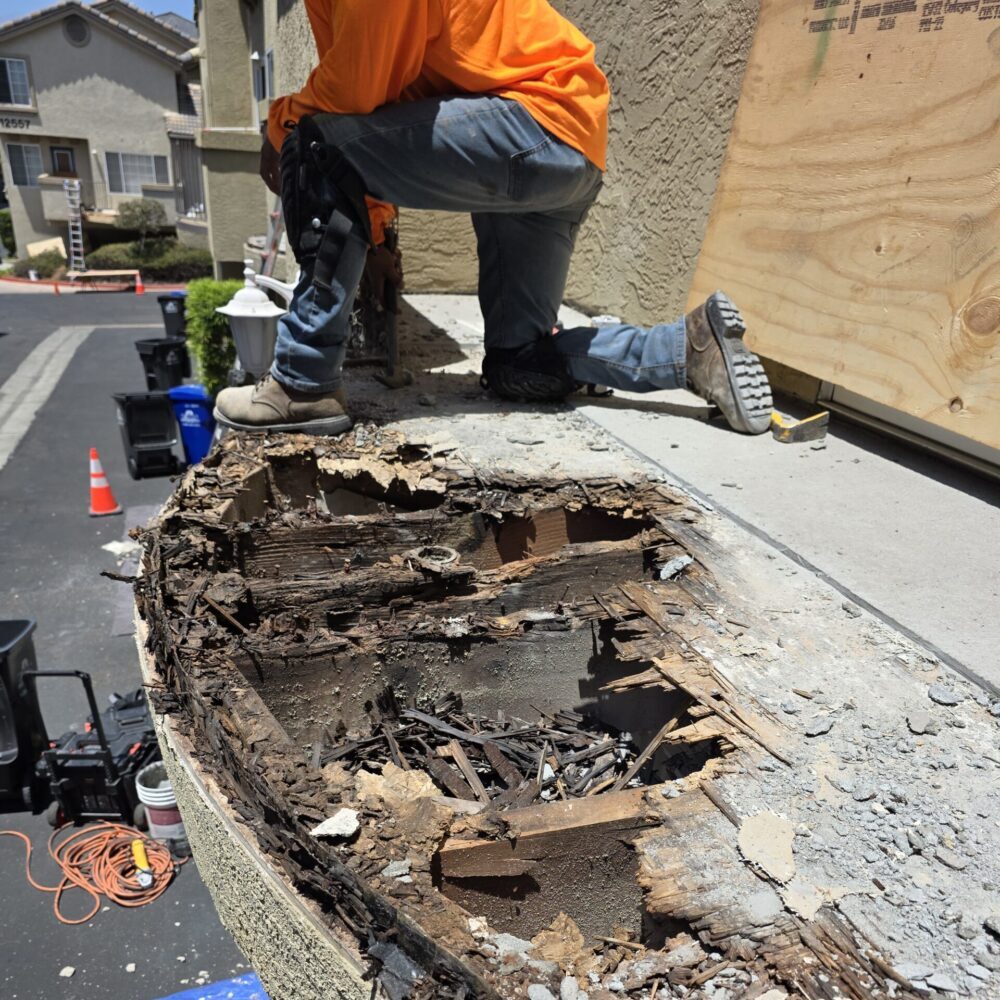
First, neither material should be treated as waterproof.
Both plywood and OSB contain wood fiber. Both react to changes in moisture. Both can be damaged by severe or prolonged moisture conditions, and neither should be used as a substitute for a properly designed waterproofing assembly.
APA notes that extended moisture exposure can produce roughness, surface changes, and thickness swelling in both plywood and OSB. It also emphasizes that the duration and severity of exposure, panel type, environmental conditions, and ability of the assembly to dry all matter. APA Wood
Where they differ is in how their construction influences moisture movement.
What happens when plywood gets wet?
Plywood absorbs moisture and can swell when wet. Changes in moisture content can also produce dimensional movement.
Its veneer construction, however, gives moisture multiple pathways to move through and out of the panel.
Research reviewed by IIBEC comparing plywood and OSB under wet conditions found that plywood generally released excess moisture more rapidly during drying periods than the OSB panels evaluated. IIBEC
That does not make plywood immune to moisture damage. Long-term moisture exposure can still lead to dimensional changes, deterioration, fungal decay, or loss of performance.
The objective of a properly designed waterproof deck is to prevent those sustained wet conditions from occurring in the first place.
What happens when OSB gets wet?
OSB is manufactured using wood strands, resins, and waxes that can initially resist moisture infiltration.
But the same panel characteristics can affect how quickly moisture leaves the material once significant wetting occurs.
IIBEC’s review of moisture-exchange research found that the evaluated OSB panels showed somewhat greater resistance to moisture infiltration but a reduced ability to release moisture after becoming wet. During cyclic wet conditions, the OSB could therefore remain at an elevated moisture content for longer periods than comparable plywood. IIBEC
APA’s current technical literature also specifically addresses thickness swelling and edge swelling as recognized considerations when working with OSB. APA Wood
Does OSB swell when it gets wet?
It can.
Like plywood, OSB changes dimension in response to moisture. Thickness swelling can be particularly noticeable around panel edges.
That does not mean every OSB panel that encounters water will permanently deform or become structurally unsound. Product quality, exposure classification, duration of wetting, panel condition, construction detailing, and drying conditions all influence the outcome.
For a waterproof deck assembly, however, even localized dimensional changes deserve attention.
A raised panel edge may no longer create the same flat plane that existed when the waterproofing assembly was installed. Movement or irregularity at panel joints can place additional stress on the materials installed across those joints.
Does OSB return to its original dimensions after drying?
Not necessarily in every circumstance.
Wood panels can shrink as they dry, but moisture-related thickness changes—especially following significant or repeated wetting—should not be assumed to disappear completely.
APA therefore treats moisture-related dimensional stability, thickness swell, linear expansion, panel spacing, and moisture management as design and installation considerations for structural wood panels. APA Wood
For waterproof decks, the better strategy is not to depend upon a panel recovering after wetting. It is to select the specified substrate, properly prepare it, and build an assembly designed to keep water out.
Why does slower drying matter?
The phrase moisture resistance can be misleading because absorbing water is only half of the equation.
Drying potential matters too.
A material that initially takes on moisture relatively slowly can still present a concern if significant moisture gets into the assembly and then has difficulty escaping.
IIBEC’s testing discussion found that, during periods of decreasing moisture, plywood released moisture more rapidly, while OSB experienced extended periods with higher retained moisture content in the evaluated assemblies. IIBEC
That is especially relevant in concealed assemblies.
Once a waterproof coating is above a structural wood deck, drying toward the exterior may be restricted. Westcoat’s own ALX Pro specification acknowledges this building-science issue by addressing moisture vapor below the waterproof membrane and requiring appropriate venting according to applicable building codes. Westcoat
Plywood vs. OSB moisture comparison
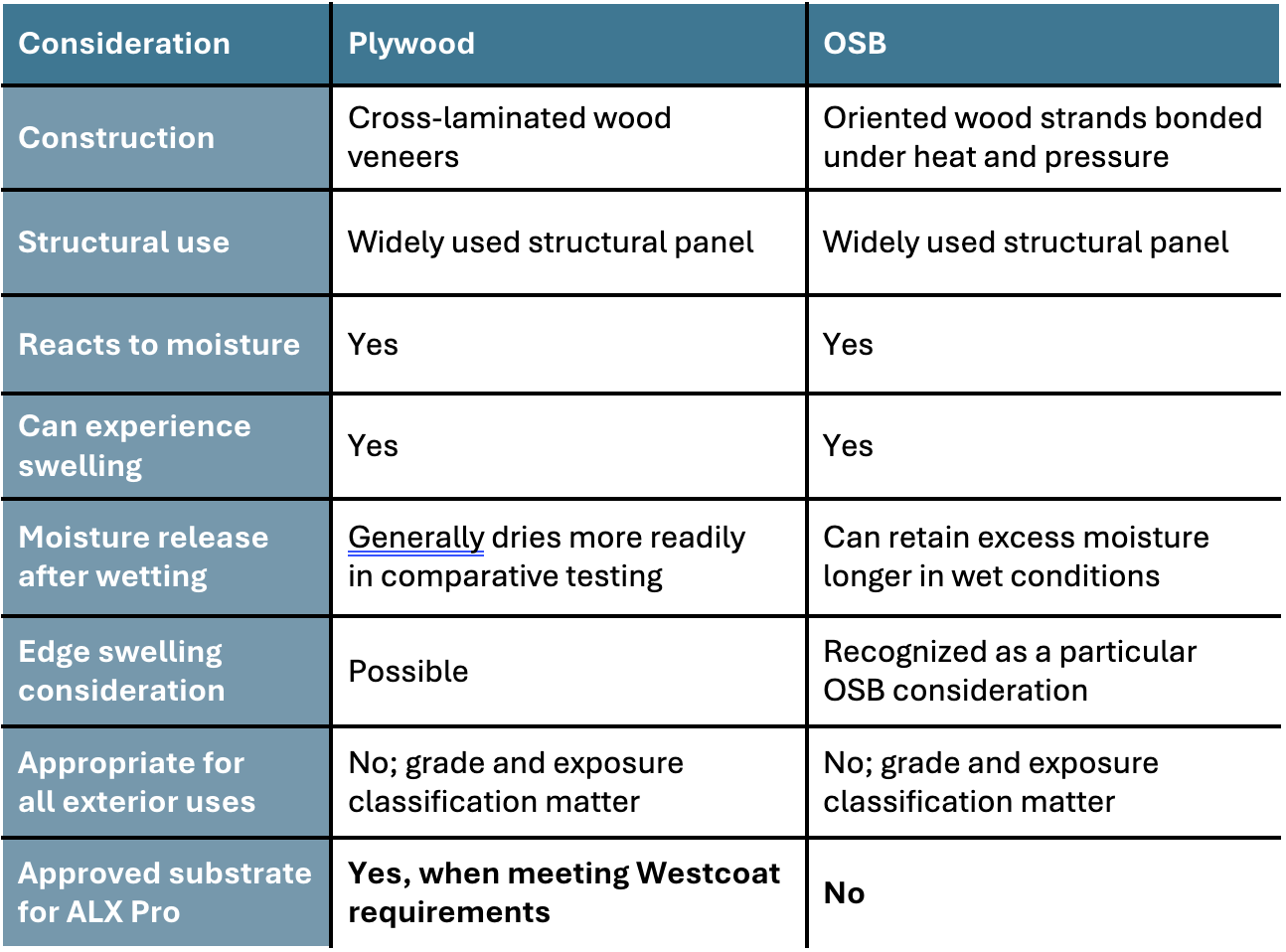
The important conclusion is not that plywood can get wet without consequence.
It cannot.
The conclusion is that moisture behavior differs between the materials, and the waterproofing system must be designed around a substrate the manufacturer has specifically evaluated and approved.
Can You Use OSB Under a Waterproof Deck Coating?
Sometimes, depending on the waterproofing system—but not under Westcoat ALX Pro.
Whether you can waterproof over OSB depends on the particular coating system, the OSB product and rating, project conditions, applicable codes, and the waterproofing manufacturer’s published requirements.
There is no universal rule that every waterproof coating can be installed over OSB simply because OSB is a structural panel.
For Westcoat ALX Pro, the current specification is explicit: “OSB is not a suitable substrate for this material.” Westcoat
That should end the substrate decision for an ALX Pro installation.
If ALX Pro is the specified waterproofing system, use the plywood substrate required by the current Westcoat specification rather than trying to adapt the system to an unapproved substrate.
This is why the question should not simply be: “Can you waterproof OSB?”
The better question is: “Is this substrate approved for the complete waterproofing assembly I am installing?”
Why Plywood Is Specified for Westcoat ALX Waterproof Deck Systems
ALX Pro is not a generic liquid coating applied directly to a wood deck.
It is a multilayer reinforced waterproof walking deck system engineered around plywood.
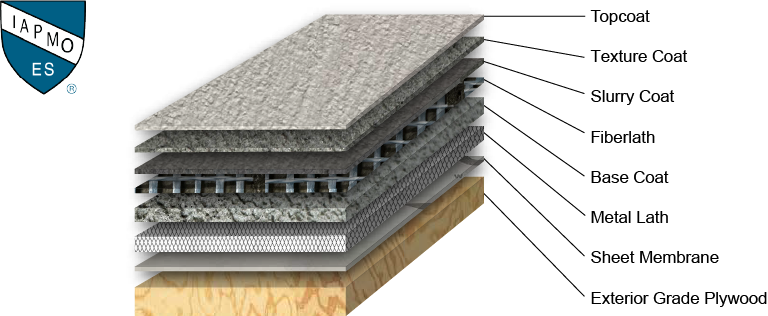
Westcoat’s current ALX Pro specification describes a bonded assembly containing reinforcing lath, a fiberlath-reinforced membrane, polymer-modified cementitious applications, and an acrylic topcoat. The system is IAPMO evaluated under ER-587. Westcoat
Just as important, Westcoat specifies the conditions of the plywood beneath that assembly.
What plywood does ALX Pro require?
The current ALX Pro Standard specification requires:
- Minimum 5/8-inch plywood
- 3/4-inch plywood preferred
- CDX or exterior grade
- Tongue-and-groove deck construction
- Complete blocking and fastening
- Maximum 16-inch joist spacing
- Deflection of less than L/360
- Minimum slope of 1/4 inch per linear foot for drainage
- A clean, dry substrate before application
The specification also identifies plywood with less than a 10% moisture reading as typically “dry” and states that ALX Pro should not be applied to wet plywood. Westcoat
These requirements demonstrate an important point: Selecting plywood is only the beginning.
Thickness, framing, blocking, fastening, slope, moisture condition, deflection, seams, flashing, and surface preparation are also part of establishing a suitable substrate.
Why is 3/4-inch plywood preferred?
A thicker panel generally provides greater stiffness than a thinner panel under otherwise comparable conditions.
On a pedestrian deck, controlling deflection and movement matters because the waterproofing and finish layers must bridge the structure below them.
Westcoat allows a minimum 5/8-inch plywood substrate but specifically states that 3/4 inch is preferred. The system also limits joist spacing to 16 inches and calls for deflection below L/360. Westcoat
Those requirements work together.
The system is not relying on the coating alone to compensate for an inadequately supported deck.
Is CDX the same as exterior-grade plywood?
Not necessarily.
This is an area where construction terminology can cause confusion.
APA explains that panels commonly called CDX plywood are often Exposure 1 panels. Exposure 1 means the adhesive bond is designed to tolerate moisture associated with construction delays and similar limited exposure—not permanent long-term weather exposure. Exterior-rated plywood is designed for repeated wetting and drying or longer-term weather exposure. APA Wood
Westcoat’s ALX Pro specification currently states “CDX or exterior grade.”
Contractors and specifiers should therefore follow the current Westcoat specification, project documents, panel certification markings, applicable codes, and design-professional requirements rather than assuming all products sold colloquially as “CDX” have identical exposure classifications.
How does ALX Pro address plywood seams?
Panel joints deserve special attention because adjacent sheets can move independently.
ALX Pro requires 6-inch WP-40 Sheet Membrane at all plywood seams for reinforcement. The specification also allows 36-inch WP-40 across the entire deck when maximum protection is desired. Westcoat
Above the prepared plywood and seam treatment, the system incorporates lath, a polymer-modified base coat, fiberlath resin membrane, additional cementitious layers, and the protective finish.
Westcoat allows either WP-25 Metal Lath or WP-30 Glass Lath. The lath is installed so its edges are offset from parallel plywood seams, adding another deliberate assembly detail rather than simply placing a coating directly over panel joints. Westcoat
ALX Pro then adds its fiberlath-reinforced resin membrane across the deck before subsequent coats are installed. Westcoat
That is why it is more accurate to think of the system as an engineered assembly rather than a waterproof paint.
What Can Happen When the Wrong Deck Substrate Is Used?
Using an unapproved substrate does not mean that every deck will immediately fail.
It does introduce variables the waterproofing manufacturer has not specified for that assembly.
Depending on the substrate, moisture conditions, framing, installation, drainage, and detailing, potential problems may include:
- Thickness or edge swelling
- Raised panel joints
- Telegraphing of seams through the finished surface
- Excessive substrate movement
- Cracking or stress in materials installed above the substrate
- Reduced adhesion when coatings are installed over damp or unsuitable surfaces
- Moisture becoming trapped within the assembly
- Deterioration of wood components if elevated moisture persists
- Premature repair or replacement of portions of the waterproofing system
APA specifically recognizes panel buckling, ridging, thickness swelling, and moisture-related dimensional movement as conditions that must be addressed through appropriate panel selection, spacing, fastening, and moisture management. APA Wood
A waterproof deck adds another complication: once multiple waterproofing, reinforcement, cementitious, and finish layers have been installed, reaching the substrate is no longer a simple repair.
Correcting a substrate problem may require removal of materials that were never the original source of the problem.
That is why substrate selection belongs at the beginning of the waterproofing conversation—not after the finish begins showing symptoms.
Plywood vs. OSB Cost: Is the Upfront Savings Worth It?
Cost is one reason OSB vs. plywood is such a common construction debate.
OSB has historically been attractive because it is generally less expensive to manufacture and purchase than comparable plywood, although actual panel pricing varies significantly by region, thickness, grade, market conditions, and availability. Fine Homebuilding
On a conventional framing package, the material savings can be meaningful.
But OSB vs. plywood cost has to be evaluated in the context of the complete project.
If a waterproofing system specifically requires plywood, the lower price of OSB does not make it a lower-cost substitute for that system. It simply makes it the wrong substrate.
Consider the sequence:
Before waterproofing:
Selecting the specified plywood affects the cost of the structural deck.
After waterproofing:
Changing the substrate can mean removing the finish, waterproofing layers, reinforcement, flashing interfaces, and panel materials before rebuilding the assembly.
The relevant comparison is therefore not simply: price of an OSB panel vs. price of a plywood panel.
It is: specified substrate cost vs. the potential cost and risk of building a waterproof assembly over a substrate the manufacturer does not approve.
For ALX Pro, there is little value in optimizing the first number while ignoring the second.
How to Choose the Right Substrate for a Waterproof Deck
The right sequence is straightforward:
Waterproofing system → Approved substrate → Structural requirements → Slope and drainage → Substrate preparation → Waterproofing installation
Not the reverse.
1. Select the waterproofing assembly
Determine the performance requirements for the balcony, deck, walkway, or roof deck.
Consider traffic, occupied space below, fire-rating requirements, code requirements, project location, finish, maintenance, and warranty expectations.
2. Verify the manufacturer’s approved substrate
Do not substitute based solely on a structural-panel equivalency.
Read the current system specification and evaluation report.
For ALX Pro, that means plywood—not OSB. Westcoat
3. Verify the structural deck
Confirm panel thickness, framing span, blocking, fastening, deflection, and other structural requirements.
ALX Pro calls for minimum 5/8-inch plywood, with 3/4 inch preferred, a maximum 16-inch joist span, and deflection below L/360. Westcoat
4. Build in positive drainage
Waterproofing should not be asked to compensate for poor water management.
ALX Pro requires a minimum slope of 1/4 inch per linear foot to provide proper drainage. Westcoat
5. Confirm the substrate is dry and suitable
Waterproofing should not encapsulate a wet substrate.
Westcoat requires a clean, dry plywood surface and identifies less than 10% moisture as the typical benchmark for dry plywood in the ALX Pro specification. Westcoat
6. Install every part of the assembly as specified
Seam membrane, flashing, lath, base coat, fiberlath resin membrane, slurry coat, texture, and topcoat are not interchangeable pieces.
They function together.
That is what “specify the assembly, not just the coating” means in practice.
Plywood vs. OSB for Waterproof Decks: The Bottom Line
Plywood and OSB are both legitimate structural building materials.
The question is not which panel is universally “good” and which is universally “bad.”
The question is: Which substrate belongs beneath the waterproofing system being installed?
For Westcoat ALX Pro, that answer is plywood.
The system was designed around a plywood deck and builds from there: specified framing conditions, seam reinforcement, lath, polymer-modified cementitious materials, a fiberlath resin membrane, and protective finish coats work together as one assembly. Westcoat
That is a more important distinction than the cost of one sheet of wood.
When the waterproof deck protects an elevated balcony, walkway, roof deck, or occupied space below, the substrate is not simply what the waterproofing sits on. It is where the waterproofing system begins.
Frequently Asked Questions About OSB vs. Plywood for Waterproof Decks
Is plywood or OSB better for a waterproof deck?
There is no universal answer for every waterproofing product. The correct substrate is the one approved by the waterproofing manufacturer and appropriate for the project’s structural and exposure requirements.
For Westcoat ALX Pro, plywood is required and OSB is identified as an unsuitable substrate. Westcoat
Can OSB be used under a waterproof deck coating?
Only when the specific waterproofing system permits it.
Being structurally acceptable sheathing does not automatically make OSB an approved waterproofing substrate. Always consult the current system specification and evaluation information before installation.
ALX Pro does not permit OSB as its substrate. Westcoat
Can you waterproof directly over OSB?
Some products or assemblies may permit waterproofing over certain OSB substrates, but there is no blanket yes-or-no answer covering every system.
If installing ALX Pro, the answer is no. Westcoat specifies plywood and identifies OSB as unsuitable. Westcoat
Can OSB be used for exterior decking?
Certain OSB products can be manufactured with exposure classifications appropriate for demanding applications, but the panel rating, structural design, intended exposure, and materials installed above it must all be considered. APA manufactures classifications for both Exposure 1 and Exterior OSB. APA Wood
That does not make OSB acceptable under a waterproof coating system that specifically requires plywood.
Can you waterproof plywood for an outdoor deck?
Yes. Plywood can serve as the structural substrate for a waterproof deck when the waterproofing system is specifically designed for plywood and all system, structural, drainage, flashing, and installation requirements are followed.
Westcoat ALX and ALX Pro are waterproof walking-deck systems formulated for plywood surfaces. Westcoat
What is the best plywood for an outdoor waterproof deck?
There is no single plywood specification that applies to every waterproof deck system.
For ALX Pro, follow the current Westcoat specification: a minimum 5/8-inch CDX or exterior-grade plywood, with 3/4-inch plywood preferred, along with the specified framing, blocking, fastening, deflection, slope, and moisture requirements. Westcoat
What thickness plywood should be used for deck waterproofing?
It depends on the waterproofing system and structural design.
For ALX Pro, Westcoat specifies a minimum 5/8-inch plywood substrate and prefers 3/4 inch. The specification also requires maximum 16-inch joist spacing and deflection of less than L/360. Westcoat
Is CDX plywood suitable for waterproof decks?
It can be when the waterproofing manufacturer’s specification permits it.
ALX Pro currently specifies CDX or exterior-grade plywood. However, “CDX” should not automatically be interpreted as “Exterior plywood.” APA notes that plywood commonly referred to as CDX is often Exposure 1, so panel markings, project requirements, and current manufacturer specifications should be verified. APA Wood
What happens if OSB gets wet under a deck coating?
The result depends on the OSB product, duration and severity of wetting, temperature, ventilation, drainage, and the assembly’s ability to dry.
OSB can experience thickness or edge swelling, and comparative moisture research indicates it can release absorbed moisture more slowly than plywood under wet/dry cycling. Persistent elevated moisture can also increase the potential for deterioration of wood materials. IIBEC
Does OSB swell when it gets wet?
Yes, OSB can experience thickness and edge swelling when exposed to sufficient moisture. Plywood also changes dimension when wet; neither structural wood panel should be treated as waterproof. APA Wood
Can plywood be installed over OSB before waterproofing?
Do not assume adding plywood over OSB automatically creates an approved ALX Pro assembly.
ALX Pro’s specification establishes requirements for the plywood deck, framing, blocking, fastening, deflection, and other conditions. An existing OSB layer underneath the plywood changes that construction.
For a project involving plywood installed over existing OSB, the assembly should be reviewed by the project design professional and Westcoat technical personnel before proceeding rather than treating the plywood overlay as an automatic workaround.
Build Waterproof Decks on the Right Foundation
A waterproof deck is only as good as the assembly beneath the finished surface.
Start with the correct substrate. Follow the specified structural and drainage requirements. Protect panel seams. Reinforce the waterproofing assembly. And install the system as it was designed and evaluated.
For plywood decks, balconies, roof decks, and walkways that demand reinforced waterproof protection, explore Westcoat ALX and ALX Pro waterproofing systems.